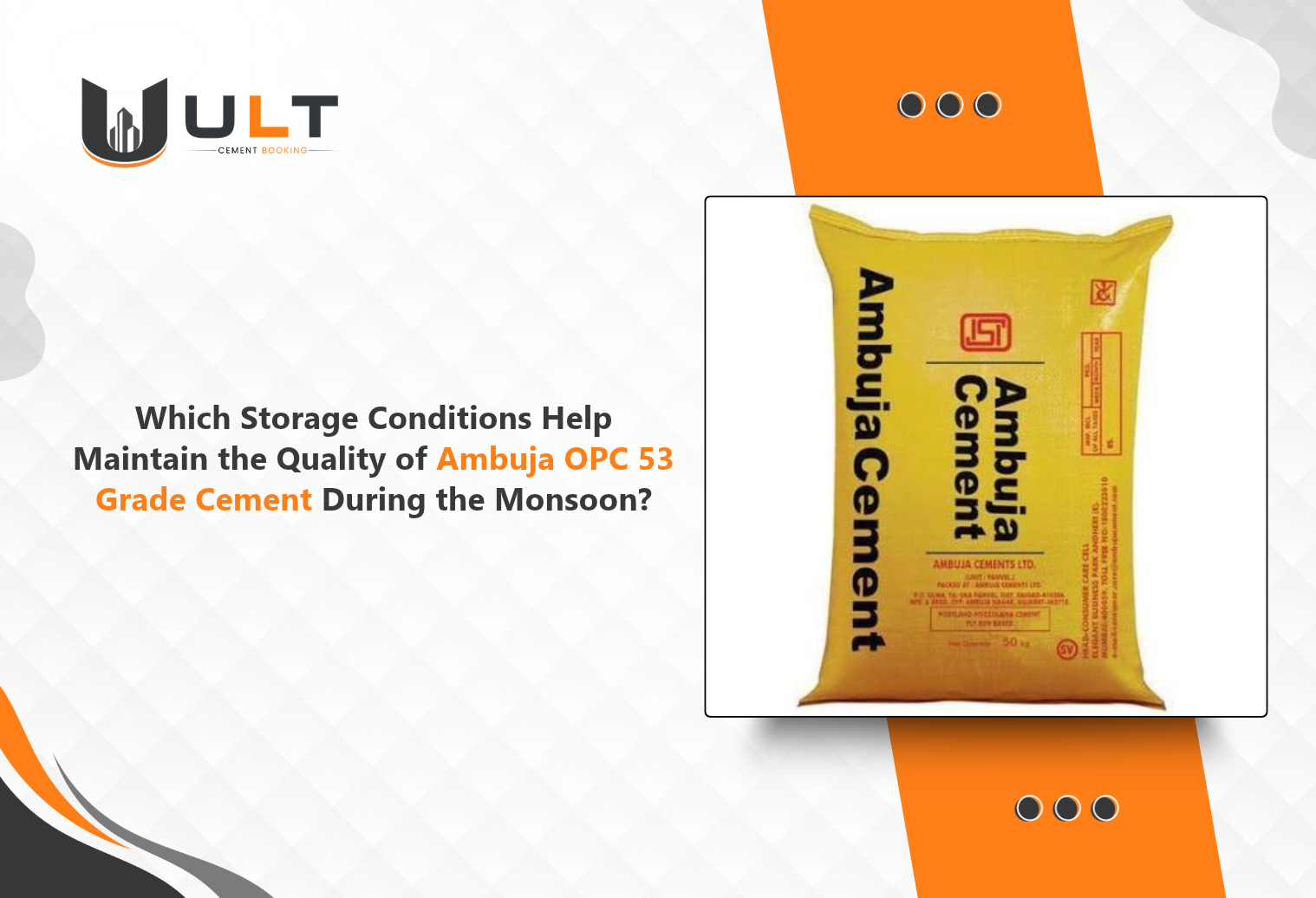
Is your site running through the rainy season? Then you may worry about your cement stock. Monsoon brings damp air, roof leaks, and wet ground. All of these can harm stored material. Good Ambuja OPC 53 Grade Cement sets early and carries heavy loads. But high humidity can ruin it before use. Bags may form lumps and lose strength. So how do you keep your stock safe in heavy rain? This guide shares simple storage rules. It also covers waterproofing tips and quick quality tests. Read on and protect your money this monsoon.
Why Is Ambuja OPC 53 Grade Cement Sensitive to Monsoon Moisture?
Monsoon air is full of water vapour. Humidity often goes above 80%. Cement soaks up this moisture very fast. This process is called aeration. It starts even when the bag looks fine from the outside. Here is what happens to your stock:
- Surface hydration: Ambuja OPC 53 Grade Cement reacts with air moisture at once. Tiny sets form inside the bag.
- Lump formation: Damp cement turns into hard lumps. These lumps make the concrete weak.
- Strength loss: Wet stock can lose 20% to 30% of its strength in a few weeks.
- Slow setting: Wet cement sets late. Then you wait longer to remove the shuttering. Your work gets delayed.
What Storage Setup Best Protects Ambuja OPC 53 Grade Cement from Rain?
You need a closed shed first. It keeps the rain off your bags. Build it before the first load comes in.
1. Roof and Wall Sealing
Construct or rent a dry shed that has a roof that doesn’t leak. The sheets of iron need to be covered with very thick tarpaulins. This will prevent rainwater from entering.
2. Wall Clearance
Never stack bags against brick or concrete walls. Outer walls soak up rainwater. That water moves straight into your bags.
3. Raised Wood Platform
Never put bags on bare ground or a concrete floor. Ground damp rises slowly. It spoils the bottom bags first.
Which Stacking Rules Preserve Ambuja OPC 53 Grade Cement Quality?
Neat stacks stop air from getting trapped. They also make it easy to use old stock first. This matters a lot in the wet months.
| Storage Parameter | Site Standard | Risk If Ignored |
| Floor Height | At least 15 to 20 cm off the ground | Ground damp spoils the bottom bags |
| Wall Gap | Keep 45 cm from outer walls | Wall seepage wets the stock |
| Stack Height | Not more than 10 bags | Weight causes lumps in lower bags |
| Stack Pattern | Cross the bags in each layer | Loose stacks fall during handling |
| Cover | Double layer of 200 GSM tarpaulin | Sudden leaks ruin open bags |
- Use raised pallets: Stack bags above dry wood or plastic pallets. This will prevent wetness from the floor completely.
- Close vents: Seal your windows, vents, and door openings during heavy rains. This will prevent moist air from getting in.
- Follow the first-in, first-out method: Do not keep any batch for more than 30 to 45 days.
How Can You Test Ambuja OPC 53 Grade Cement for Moisture Damage on Site?
Before mixing Ambuja OPC 53 Grade Cement for columns, beams, or slabs, do four simple tests. They will not take long. They may prevent you from making an expensive error.
| Test | Fresh Cement | Damaged Cement |
| Look | Even greenish-gray color | White spots or hard lumps |
| Touch | Smooth and cool | Rough, warm, or gritty |
| Water Float | Floats for a moment, then sinks | Sinks at once like a stone |
| Hardness | Lumps crush with fingers | Lumps resist thumb pressure |
- Colour test: Open a bag of cement and observe the colour of the top. Ambuja OPC 53 Grade cement is good.
- Pinch test: Take some cement between your fingers and pinch it. Cement has to be light and smooth. Grit means damaged cement.
- Hand test: Dip your hand in the bag deeply. Cement should feel cold. Otherwise, the cement has undergone the hydration process.
- Powder test: Press the lumps in the bag with your fingers. If they powderize, then you can use the cement. It has an even greenish-grey colour. It should have no patches.
What Common Monsoon Storage Mistakes Damage Ambuja OPC 53 Grade Cement?
Small site errors can cost you thousands of rupees. They can also force rework later. Avoid these four.
- Storing outdoors: Never leave Ambuja OPC 53 Grade Cement outside under a plastic sheet at night. Rain and wind will find a way in.
- Too many bags: Don’t stack more than 10 bags. The weight crushes the bags at the bottom. The powder turns into hard lumps.
- Mixing old and new: Don’t put new bags on top of old ones. The old stock gets buried and forgotten. By the time you find it, it has gone bad.
- Open doors: Keep the shed door shut during the day. Open doors let damp air in. The bags soak it up for hours.
How Does Proper Monsoon Storage Ensure Maximum Concrete Strength?
Dry stock gives you better concrete. It also makes your building safer and longer-lasting. Here is what you gain:
- Strong bond: Dry Ambuja OPC 53 Grade Cement bonds well with TMT steel bars.
- Fewer cracks: Fresh cement hydrates steadily. This cuts tiny cracks in slabs and beams.
- Full strength: Good storage helps concrete reach its 53 N/mm² rating at 28 days.
- Less waste: No bag is lost to damp. Every bag you buy goes into the build.
Conclusion
A strong building needs real materials that arrive on time. At ULT Cement Booking, we simplify your supply. We connect you with top brands like UltraTech, Ambuja, ACC, Dalmia, Birla, and JK Cement. Our rates are clear and fair. Whether you need Ambuja OPC 53 Grade Cement or TMT steel bars, we send fresh batches. You also get real quality certificates. Delivery to your site is quick.
Have questions about monsoon storage, bag prices, or bulk orders? Message us on WhatsApp. Our team will share an instant quote for your project. Store smart. Build strong.
Frequently Asked Questions
What is OPC 53 grade cement?
OPC 53 is a high-strength cement. After 28 days, it reaches 53 MPa. Builders use it for tall buildings, bridges, and quick jobs.
Which is better, OPC 43 or OPC 53?
It depends on the work. OPC 53 is good for columns, beams, footings, and slabs. It gains strength fast. OPC 43 is good for plaster, tiles, and brickwork. Those jobs don’t need that much strength.
Which is the best OPC 53 cement?
India has a few good brands. Ambuja, UltraTech, ACC, and Dalmia are the common ones. Many builders pick Ambuja OPC 53 Grade Cement for its fine grain and steady quality.
How long can you store Ambuja OPC 53 Grade Cement during monsoon?
Try to use it within 30 days. After 45 days, it may take in damp air, even inside a shed. That makes it weaker. So use the old bags first.
Can you use Ambuja OPC 53 Grade Cement with small moisture lumps?
Press the lumps with your thumb. If they turn to powder, you can use the cement for light work. A floor base is one example. If the lumps stay hard, don’t use it. Keep it away from columns, beams, and slabs.